Wednesday, March 30, 2011
Silver Maple---A Tree Not Recommended Close to A House or Septic System
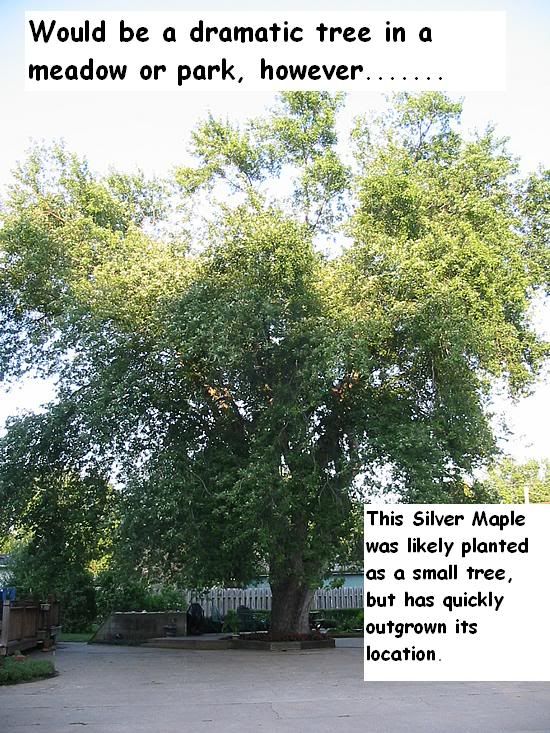
The Silver maple (Acer saccharinum) is somewhat like the Norway maple (Acer plantanoides) as the tree does have some critics. The silver maple is a fast growing tree and because of its fast growth and equally spreading root system, the tree is weak wooded and should most definitely not be placed in a landscape near a house, sidewalk or septic system.
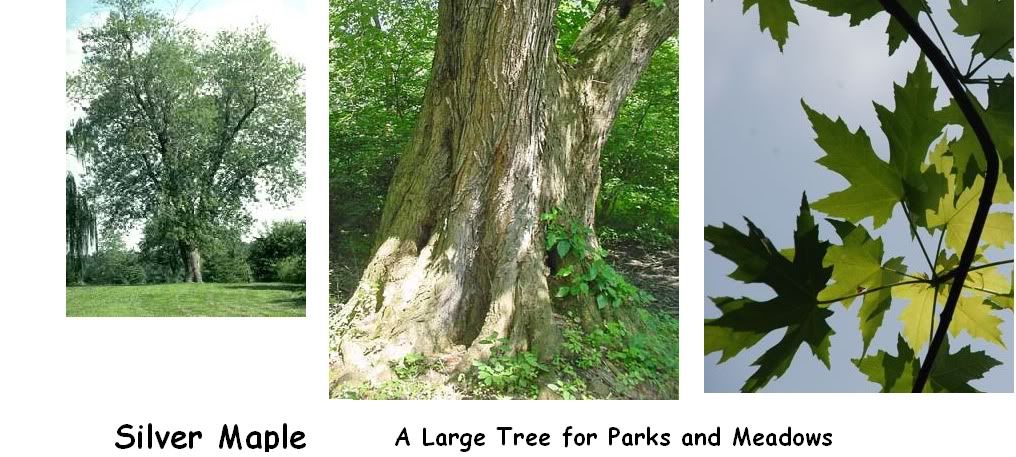
When people would come to the garden center, I was initially a one-time detractor of this native tree of the eastern United States and southeast Canada. As a kid growing up in an Akron, Ohio suburb, our neighbors had planted two silver maples, which quickly outgrew the small lot. Their silver maple trees were large, had many lower branches sprouting at the base of the tree, had fall colors of a mottled yellow and defoliated quite early.
My opinion for the silver maple changed when my wife prior to our marriage purchased our current home. There is a large stately silver maple tree (height of 75 feet) along the driveway to our house. The tree provides a nice filtered shade, however as noted earlier, after winter or a summer storm there are often times significant branch droppings. But like a family member with some irritating habits, we still like the tree.
My recommendation would be to plant a silver maple in a large park area where there is a need for a fast growing tree (new growth can be 1 foot a year) or in a somewhat naturally swampy area of a landscape—again away from septic systems.
Back to the tree along our driveway.
The tree in our yard appears to be a likely natural cross between a silver and red maple. The silver and red maple crosses (Acer saccharinum x Acer rubrum) are quite common and have been deliberately hybridized to achieve the fast growth of the silver maple and the less brittle wood and less invasive roots of the red maple. The leaves, buds, and silhouette (shape) on our tree closely resemble a silver maple, but many branches in the leaves have the characteristic red fall coloration of the red maple and in the spring there are very pronounced red flower buds.
Monday, March 28, 2011
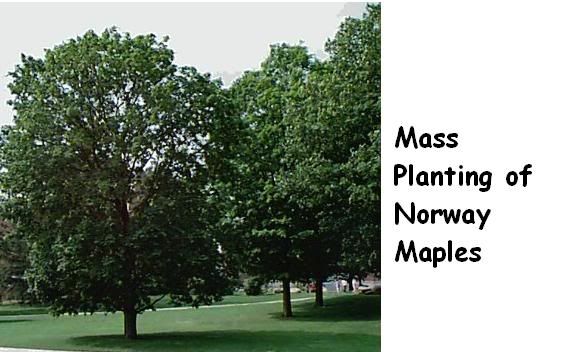
The Norway Maple Despite Its Reputation Does Have a Place in the Landscape
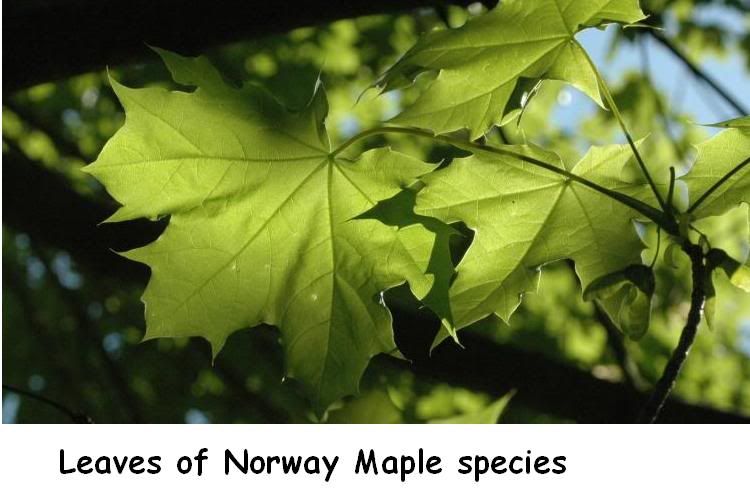
The Norway maple (Acer platanoides) as a maple tree is somewhat a controversial tree for the home landscape.
The Norway maple is native to Europe (Norway and Sweden; Caucasus Mountains in Turkey and Iran) and was introduced to North America in the mid 1700s. The Norway maple became popular as a tree planted along streets but eventually with the tree’s heavy seed production; this European native has naturalized in many northeastern forests.
Able to thrive under the shade canopy of native trees, the Norway maple grows fast and will crowd out other under story native plants with its intense shade and shallow roots. (The tree will likewise shade out a lawn---so buyers beware!) Now considered an invasive species, the tree is no longer sold in New Hampshire or Massachusetts and some garden centers will no longer sell the tree.
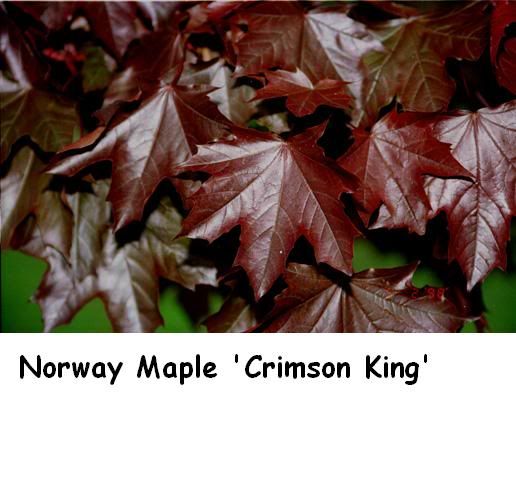
However, there are many red-leafed Norway maple cultivars, which can not be beat for the spring and summer leaf color they bring to the home landscape. Unlike the species, the Norway maple cultivars produce substantially fewer if any seeds and the seeds, which do drop, are less likely to germinate.
The Norway maple cultivars to consider for the home or commercial landscape are:
'Cleveland'
Has an upright oval habit with dense dark foliage
'Crimson King’ (mistakenly referred by customers as a red maple)
Leaves are a rich maroon fall color and is considered to be the most vigorous of the red-leafed varieties
'Emerald Queen'
Ascending branches with an upright oval shape and bright yellow fall color
'Schwedleri'
Purplish red leaves in the spring turning to green in later spring.
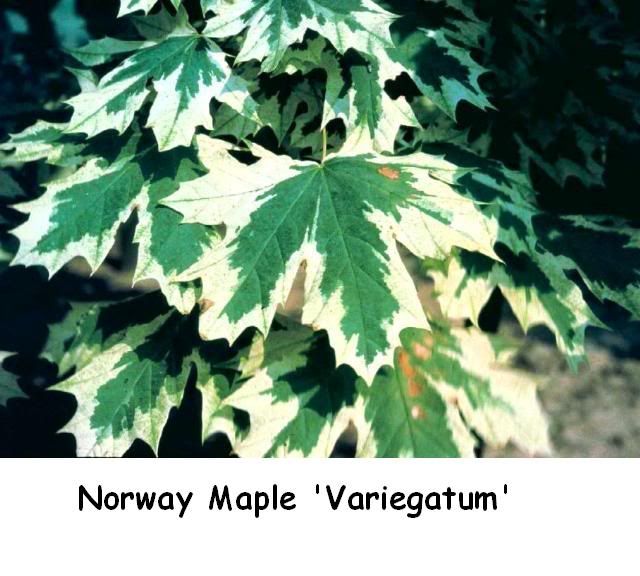
‘Variegatum’
Green leaves with white margins
Unlike the Red and Sugar maples, the Norway maple is not used for maple syrup production and the tree’s fall colors are bright yellows, which often times emerge after the other trees have already changed and dropped their leaves.
The Norway maple is native to Europe (Norway and Sweden; Caucasus Mountains in Turkey and Iran) and was introduced to North America in the mid 1700s. The Norway maple became popular as a tree planted along streets but eventually with the tree’s heavy seed production; this European native has naturalized in many northeastern forests.
Able to thrive under the shade canopy of native trees, the Norway maple grows fast and will crowd out other under story native plants with its intense shade and shallow roots. (The tree will likewise shade out a lawn---so buyers beware!) Now considered an invasive species, the tree is no longer sold in New Hampshire or Massachusetts and some garden centers will no longer sell the tree.
However, there are many red-leafed Norway maple cultivars, which can not be beat for the spring and summer leaf color they bring to the home landscape. Unlike the species, the Norway maple cultivars produce substantially fewer if any seeds and the seeds, which do drop, are less likely to germinate.
The Norway maple cultivars to consider for the home or commercial landscape are:
'Cleveland'
Has an upright oval habit with dense dark foliage
'Crimson King’ (mistakenly referred by customers as a red maple)
Leaves are a rich maroon fall color and is considered to be the most vigorous of the red-leafed varieties
'Emerald Queen'
Ascending branches with an upright oval shape and bright yellow fall color
'Schwedleri'
Purplish red leaves in the spring turning to green in later spring.
‘Variegatum’
Green leaves with white margins
Unlike the Red and Sugar maples, the Norway maple is not used for maple syrup production and the tree’s fall colors are bright yellows, which often times emerge after the other trees have already changed and dropped their leaves.
Friday, March 25, 2011
Red Maple Tree Flowers Are Starting to Emerge
The red maple, Acer rubrum, and its cultivars are one of the most popular trees for residential and commercial landscaping.
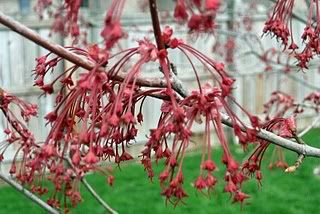
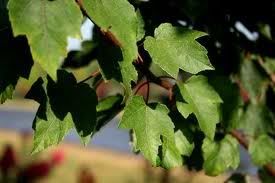
Allowed to grow in the woods, the red maple can become a large tree with a mature height of 50 ft. The red maple's flowers, petioles, new growth, and seeds all are red to varying degrees and can be quite showy when first emerging in the spring. After the spring colors, the red maple's clean cut leaves emerge.
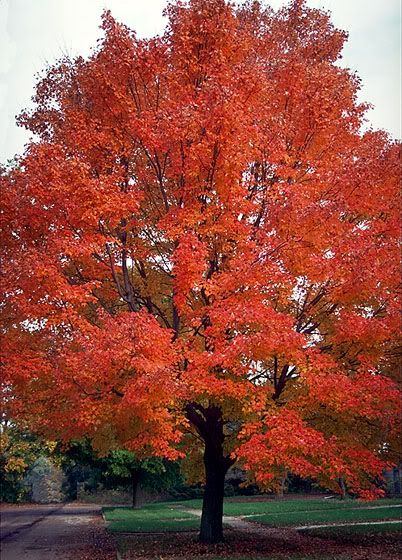
The red maple tree however, is best known for its fall colors which range from deep scarlets to reddish oranges.
The fall color (generally a 1-2 week event) is the major reason homeowners select a red maple tree. However, the other remaining weeks of the year are equally as important when selecting this tree.
The young commercially cultivated red maple varieties appear to maintain somewhat of a manicured look with either an oval or upright oval appearance. In the summer, red maple leaves are smaller than other maple varieties and contrast nicely with the silvery white trunk of a younger tree. By no means a small tree, recommendations would be to plant the tree a minimum of 30-40 away from any structures.
There are many cultivars of red maples, which are available at garden centers. Four varieties I would recommend are:
'October Brilliance'
Slow to leaf out in spring, has a tight crown and deep red fall color
'October Glory'
Rounded oval crown with late developing intense red fall foliage. Though the fall color is brilliant, when other trees have already peaked in their fall coloration, the ‘October Glory," is often times much later in its coloration.
'Red Sunset'
Heat tolerant, upright growth habit, drought tolerant, upright habit, orange-red fall color, and is also a rapid and vigorous grower.
'Autumn Blaze'
Rounded oval form with leaves that resemble silver maple. The fall color is orange red and persists longer than usual
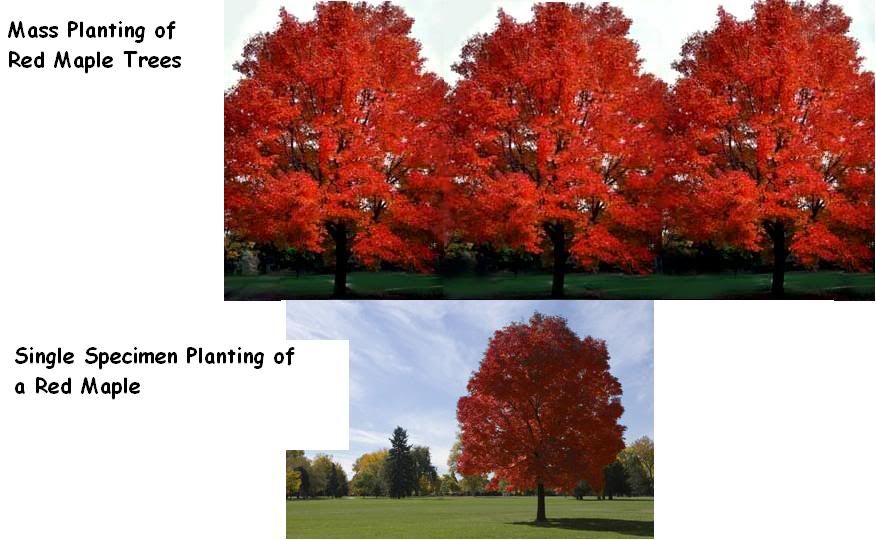
An effective use of the red maple is to plant only one tree in the landscape as a specimen tree. Another use is to plant a mass planting (three or more trees of the same variety) in the landscape. Due to the different growth habits and the timing of fall coloration, when doing a mass planting of red maples, use the same variety for a much more effective look.
Allowed to grow in the woods, the red maple can become a large tree with a mature height of 50 ft. The red maple's flowers, petioles, new growth, and seeds all are red to varying degrees and can be quite showy when first emerging in the spring. After the spring colors, the red maple's clean cut leaves emerge.
The red maple tree however, is best known for its fall colors which range from deep scarlets to reddish oranges.
The fall color (generally a 1-2 week event) is the major reason homeowners select a red maple tree. However, the other remaining weeks of the year are equally as important when selecting this tree.
The young commercially cultivated red maple varieties appear to maintain somewhat of a manicured look with either an oval or upright oval appearance. In the summer, red maple leaves are smaller than other maple varieties and contrast nicely with the silvery white trunk of a younger tree. By no means a small tree, recommendations would be to plant the tree a minimum of 30-40 away from any structures.
There are many cultivars of red maples, which are available at garden centers. Four varieties I would recommend are:
'October Brilliance'
Slow to leaf out in spring, has a tight crown and deep red fall color
'October Glory'
Rounded oval crown with late developing intense red fall foliage. Though the fall color is brilliant, when other trees have already peaked in their fall coloration, the ‘October Glory," is often times much later in its coloration.
'Red Sunset'
Heat tolerant, upright growth habit, drought tolerant, upright habit, orange-red fall color, and is also a rapid and vigorous grower.
'Autumn Blaze'
Rounded oval form with leaves that resemble silver maple. The fall color is orange red and persists longer than usual
An effective use of the red maple is to plant only one tree in the landscape as a specimen tree. Another use is to plant a mass planting (three or more trees of the same variety) in the landscape. Due to the different growth habits and the timing of fall coloration, when doing a mass planting of red maples, use the same variety for a much more effective look.
Wednesday, March 16, 2011
The Sugar Maple Tree --- A Slow Growing Shade Tree
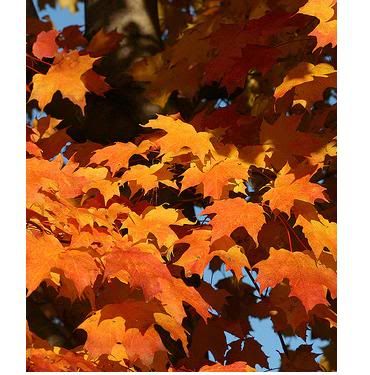
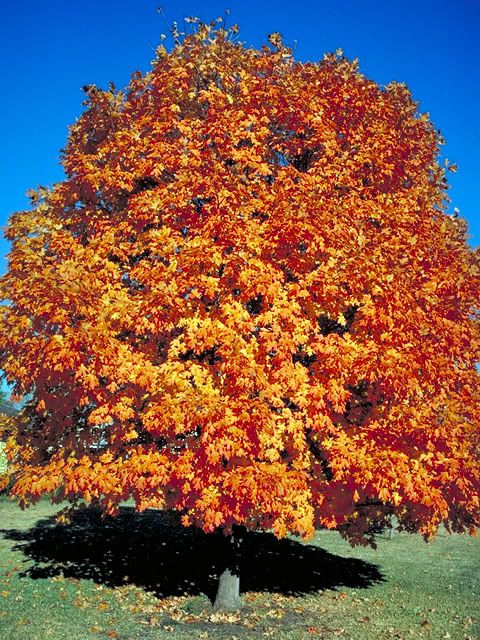
The Sugar Maple tree (Acer saccharum) is probably noted most for maple syrup production and tremendous fall colors of oranges, reds, and yellows.
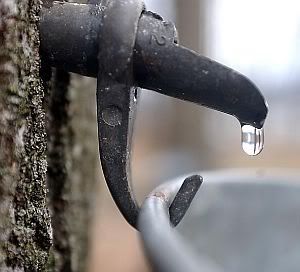
Though other maple tree saps can be used in syrup production, sugar maple sap is most preferred due to the higher concentration of sugar. On the average, it takes 40-50 gallons of sap to produce one gallon of maple syrup---hence the syrup’s high cost.
The sugar maple tree can become a large tree. When growing in the wild, the tree can attain heights of 60-100 feet with a good clean trunk, which makes the tree all the more valuable for commercial use. With densely packed tree cells, sugar maple wood is considered a hard wood and has many commercial uses particularly for flooring and furniture.
However, when planted in the home landscape, parks, or on residential boulevards, the tree develops a more oval shape with lower limbs. Compared to other maple trees, the sugar maple would be considered a slow growing tree.
As discussed earlier, a cultivar is a plant (in this case a tree) that is selectively and maintained through human cultivation. Sugar maple tree cultivars have been developed specifically for use in the home landscape and the plant breeders own plant patents to the varieties they have developed.
There are many nurseries promoting sugar maple cultivars that have been cultivated for their fall colors, tree shape, and more rapid growth and drought tolerance compared to the parent tree. These sugar maple varieties can be located either at your local garden center, nurseries, or on-line.
Some of the better known Sugar Maple cultivars are:
Acknowledgement:
Michigan State University Extension
Ornamental Plants plus Version 3.0 - 00000031
11/12/99
http://web1.msue.msu.edu/imp/modzz/00000031.html
University of Minnesota Extension Services Maple Series (2009) Carl Vogt
http://www.extension.umn.edu/distribution/naturalresources/DD6286.html
Though other maple tree saps can be used in syrup production, sugar maple sap is most preferred due to the higher concentration of sugar. On the average, it takes 40-50 gallons of sap to produce one gallon of maple syrup---hence the syrup’s high cost.
The sugar maple tree can become a large tree. When growing in the wild, the tree can attain heights of 60-100 feet with a good clean trunk, which makes the tree all the more valuable for commercial use. With densely packed tree cells, sugar maple wood is considered a hard wood and has many commercial uses particularly for flooring and furniture.
However, when planted in the home landscape, parks, or on residential boulevards, the tree develops a more oval shape with lower limbs. Compared to other maple trees, the sugar maple would be considered a slow growing tree.
As discussed earlier, a cultivar is a plant (in this case a tree) that is selectively and maintained through human cultivation. Sugar maple tree cultivars have been developed specifically for use in the home landscape and the plant breeders own plant patents to the varieties they have developed.
There are many nurseries promoting sugar maple cultivars that have been cultivated for their fall colors, tree shape, and more rapid growth and drought tolerance compared to the parent tree. These sugar maple varieties can be located either at your local garden center, nurseries, or on-line.
Some of the better known Sugar Maple cultivars are:
- Green Mountain (Acer saccharum ‘Green Mountain’)
- Adirondak TM (Acer saccharum ‘Adirzam’)
- Fairview (Acer saccharum ‘Fairview’)
Acknowledgement:
Michigan State University Extension
Ornamental Plants plus Version 3.0 - 00000031
11/12/99
http://web1.msue.msu.edu/imp/modzz/00000031.html
University of Minnesota Extension Services Maple Series (2009) Carl Vogt
http://www.extension.umn.edu/distribution/naturalresources/DD6286.html
Tuesday, March 15, 2011
Maple Tree Species Bring a Variety of Sizes, Shapes, and Leaf Colors to the Landscape
Today is an absolutely dreary day in Ohio.
As I was coming up to the house, I noticed that my neighbors had tapped the maple trees on their property for maple syrup production. A far more clever person than I am, my neighbor is an engineer by trade who not only makes his own maple syrup, but also carves his own wood to make some great furniture and wood bowls.
This site of the white buckets hanging from the tree help provide for the idea of this column: the landscape value of the maple tree. Right up there with the oak tree, the maple tree species is one of my favorite trees.
There are at least one hundred species of maple in the world. Fourteen of these are native to the United States. The following four species and their cultivars are used quite extensively in the landscape trade:
Unlike the oak tree species, which generally consists of large trees without any remarkable varied seasonal characteristics, the maple species has varieties, which vary in size with many different shapes and leaf colors.
Some species of maple trees may be large shade trees as the fast growing Silver Maple. Other species as the Japanese Maple grows small (20’ or less) and can be successfully trimmed to remain small. The smaller sized Japanese Maple and its cultivars offer many different landscape shapes and different leaf color foliage and textures for the landscape. Tree cultivars of the Norway Maple not only have green leaves, but many Norway Maple cultivars have permanent summer foliage colors of red; yellow, or variegated. The Red Maple is a medium sized shade tree in most landscapes and many of its cultivars are selected for their fall colors of yellows, orange-reds, and very deep reds.
In the next several blogs, I will be discussing more specifics regarding the landscape value of particular maple tree species for home and business landscapes.
As I was coming up to the house, I noticed that my neighbors had tapped the maple trees on their property for maple syrup production. A far more clever person than I am, my neighbor is an engineer by trade who not only makes his own maple syrup, but also carves his own wood to make some great furniture and wood bowls.
This site of the white buckets hanging from the tree help provide for the idea of this column: the landscape value of the maple tree. Right up there with the oak tree, the maple tree species is one of my favorite trees.
There are at least one hundred species of maple in the world. Fourteen of these are native to the United States. The following four species and their cultivars are used quite extensively in the landscape trade:
- Sugar Maple (Acer saccharum)
- Red Maple (Acer rubrum)
- Silver Maple (Acer saccharinum)
- Norway Maple (Acer platanoides)
- Japanese Maple (Acer palmatum)
Unlike the oak tree species, which generally consists of large trees without any remarkable varied seasonal characteristics, the maple species has varieties, which vary in size with many different shapes and leaf colors.
Some species of maple trees may be large shade trees as the fast growing Silver Maple. Other species as the Japanese Maple grows small (20’ or less) and can be successfully trimmed to remain small. The smaller sized Japanese Maple and its cultivars offer many different landscape shapes and different leaf color foliage and textures for the landscape. Tree cultivars of the Norway Maple not only have green leaves, but many Norway Maple cultivars have permanent summer foliage colors of red; yellow, or variegated. The Red Maple is a medium sized shade tree in most landscapes and many of its cultivars are selected for their fall colors of yellows, orange-reds, and very deep reds.
In the next several blogs, I will be discussing more specifics regarding the landscape value of particular maple tree species for home and business landscapes.
Wednesday, March 9, 2011
White Oak--Too Large for the Home Landscape but Great for Lumber
Any species of the oak trees is a personal favorite of mine. One all time favorite is the white oak.
In the previous article I discussed the Pin Oak Tree (Quercus palustris). Don’t get excited about the Latin insertion, as I will address plant nomenclature in an upcoming article shortly.
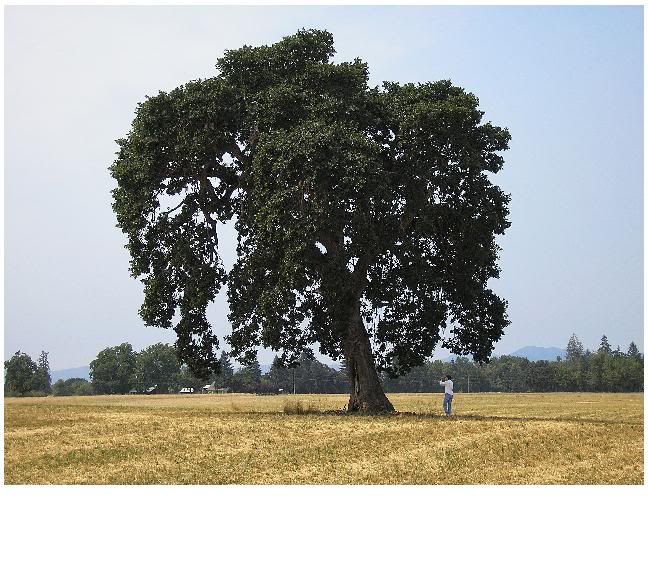
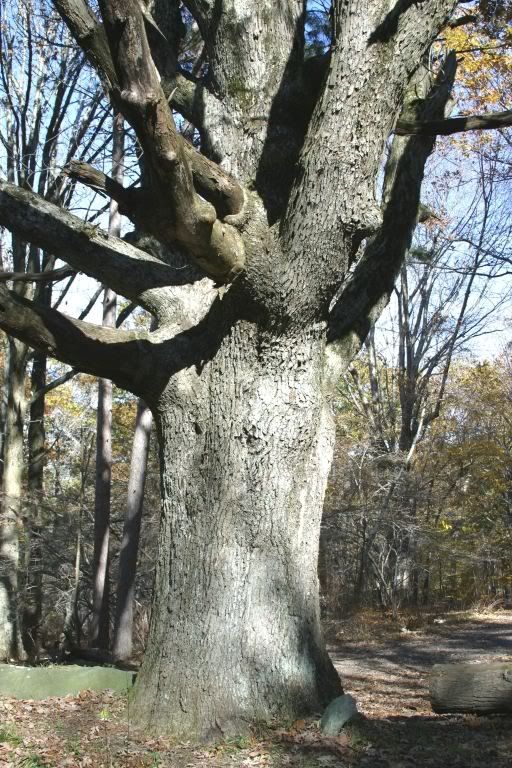
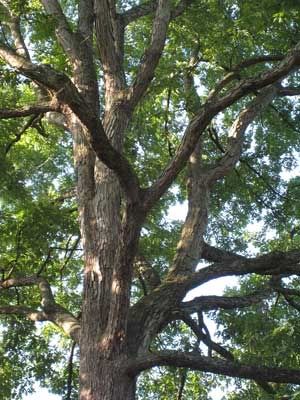
The pin oak and other oak species are suitable for residential and commercial landscape but the white oak (Quercus alba) not suitable for the small home landscape. This large oak is more suited on a park or on a golf course where the tree can be allowed to grow to its very large size. A mature white oak is as impressive to eastern United States residents as the large redwoods of California are to the residents of the west coast.
The white oak is native to eastern North America, ranges up to southern Quebec, to eastern Minnesota and south to northern Florida and eastern Texas.
Being long lived (some have lived to be 600 years), the oak can obtain a size of 65-85 feet, with a very large spread sometimes equal to the spread. Unpruned, the white oak can easily maintain lower branches, which take on an impressive size, as do the higher limbs of the tree.
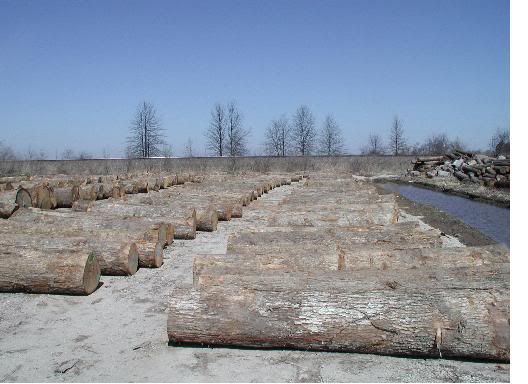
The tree’s size and intolerance to soil compaction of urban development makes the tree most unsuitable for landscape. However, the white oak continues to be an important tree for lumber.
Due to its compact cellular structure, white oak wood is very impervious to water. Because of this imperviousness to water, the oak is used to make wine and whiskey barrels, and used in home construction and shipbuilding.
Historically, the ship the USS Constitution was constructed from white oak and the white oak has been adopted as the state tree of Illinois, Connecticut, and Maryland.
In the previous article I discussed the Pin Oak Tree (Quercus palustris). Don’t get excited about the Latin insertion, as I will address plant nomenclature in an upcoming article shortly.
The pin oak and other oak species are suitable for residential and commercial landscape but the white oak (Quercus alba) not suitable for the small home landscape. This large oak is more suited on a park or on a golf course where the tree can be allowed to grow to its very large size. A mature white oak is as impressive to eastern United States residents as the large redwoods of California are to the residents of the west coast.
The white oak is native to eastern North America, ranges up to southern Quebec, to eastern Minnesota and south to northern Florida and eastern Texas.
Being long lived (some have lived to be 600 years), the oak can obtain a size of 65-85 feet, with a very large spread sometimes equal to the spread. Unpruned, the white oak can easily maintain lower branches, which take on an impressive size, as do the higher limbs of the tree.
The tree’s size and intolerance to soil compaction of urban development makes the tree most unsuitable for landscape. However, the white oak continues to be an important tree for lumber.
Due to its compact cellular structure, white oak wood is very impervious to water. Because of this imperviousness to water, the oak is used to make wine and whiskey barrels, and used in home construction and shipbuilding.
Historically, the ship the USS Constitution was constructed from white oak and the white oak has been adopted as the state tree of Illinois, Connecticut, and Maryland.
Tuesday, March 8, 2011
The Pin Oak Tree --- A Great Shade Tree for the Yard
As you become familiar with my writing style for most of the trees and shrubs, I will be looking at the following basic characteristics when describing a plant’s uses.
- Plant Growth Habit
- Plant Hardiness
- Landscape Use
When my parents started adding shade trees to their home, they added two pin oaks. After over 40 years the trees are doing well, are over 60 feet in height, and tower over their home. This early introduction to the pin oak made the tree a must have in my yard and the tree has always been a great seller in Ohio garden centers.
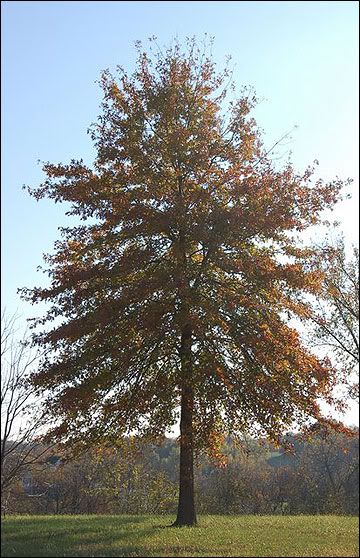
The pin oak’s growth shape is best described as pyramidal as a young tree. When you think of a pyramidal shape envision a triangular shaped object. If not pruned the tree limbs will reach down and touch the ground further accentuating the pyramidal shape. For most of us, we need to trim the lower branches so we can mow under the tree.
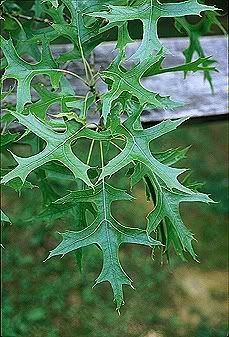
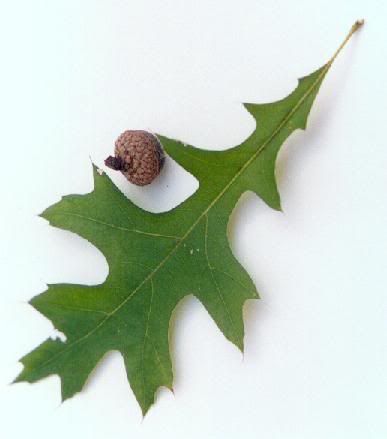
The pin oaks leaves are pointed and dark gloss green and persist on the tree through the winter months as a very brown color. The fall color of the pin oak can be a mottled yellow-brown color and in color though I have seen some great reddish brown coloration.
As the tree matures great crops of acorns are produced.
The tree is generally very hardy though galls (growths caused by insects) and iron chlorosis can be problems. The most destructive insect can be the gypsy moth, though fortunately through area management; there have not been major infestations in the area we live.
The pin oak becomes a large tree (60-70’ in height with a 25-40’). So the best location for this tree in the home landscape is sufficient distance from the house. I would recommend a minimum of 20 feet from the house---though further would be best!
Subscribe to:
Posts (Atom)